

It is hard to imagine modern life without the use of lasers. Both adults and children are familiar with them, and lasers are now applied not only in scientific fields but also in everyday life. Lasers are used in biology, industry, and the military, as well as for data storage, measuring cosmic distances, and projection television. In medicine, lasers are especially valuable, used as scalpels in surgeries or for operations on the retina. The advent of the laser is credited to a scientist from Vancouver—Theodore Maiman. More on this can be found at ivancouver.
Prerequisites for Creating the Laser
Theodore Maiman was not the first physicist to work on creating a laser. The groundwork for its invention was laid by German scientist Max Planck, who discovered the quantum, a fundamental unit of energy, in 1900. For this, he was awarded the Nobel Prize in 1918. Around the same time, Albert Einstein discovered the photon, the smallest elementary particle of light, and formulated the theory of “stimulated emission,” which described the possibility of creating conditions where electrons simultaneously emit light of the same wavelength. This theoretical framework made it possible to conceive a controllable electromagnetic emitter.
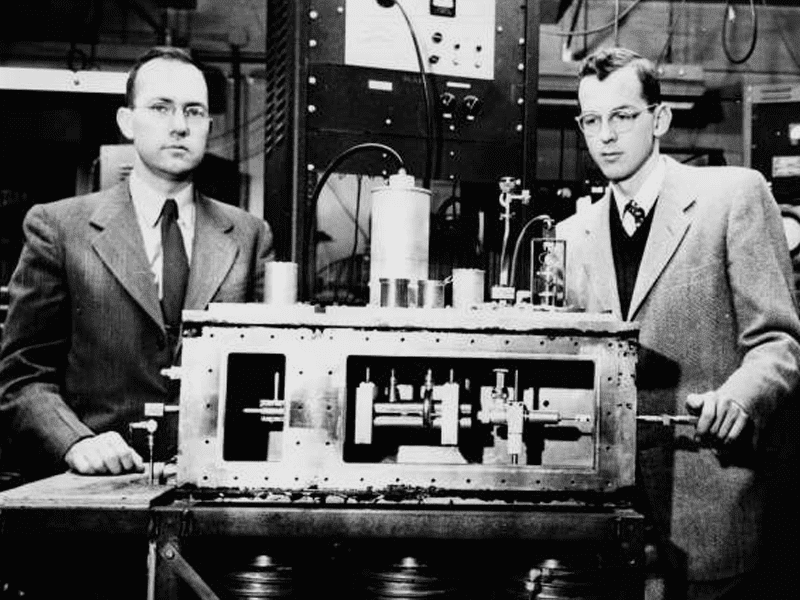
In 1951, Charles Townes attempted to implement Einstein’s theory by creating an appropriate device. Along with Herbert Zeiger and James Gordon, he succeeded in building the world’s first functional “maser.” However, this device operated outside the optical range, rendering it invisible to the human eye.
How Theodore Maiman Gained Fame
When developing the laser, Maiman focused on amplifying light rather than microwaves, as the maser did. The Vancouver-based scientist diverged from the path proposed by Townes and Schawlow, favoring experiments with solid-state materials instead of gasses. Therefore, instead of a gas-based potassium system used in the maser, Theodore opted for a ruby crystal.
The ruby used in Maiman’s laser was a small synthetic rod with silvered ends. When light struck the rod, chromium atoms inside became excited, initiating an internal chain reaction. This process released photons that bounced between the silvered ends of the rod, causing further excitation of atoms and photon emission. Eventually, the stimulated emission generated enough energy for a photon pulse to pierce through one silvered end of the ruby rod, producing a narrow beam of monochromatic light.
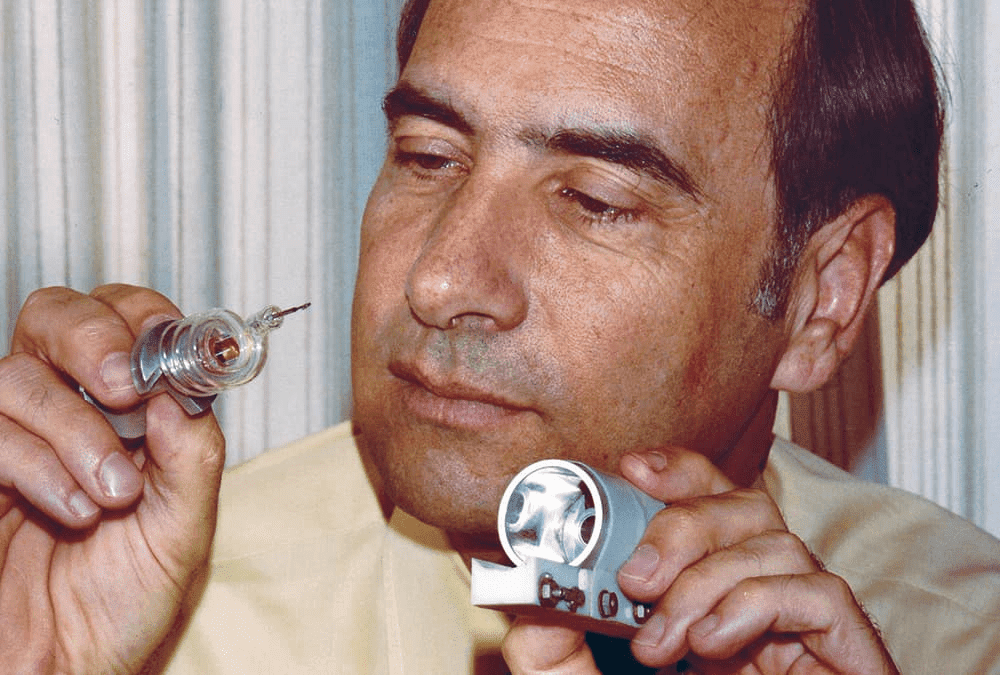
Eager to announce his breakthrough, Maiman submitted his first article to Physical Review Letters, but it was rejected. He then revised the publication, condensing it to 300 words and submitting it under the title “Stimulated Optical Emission in Ruby” to Nature. The article was published in August 1960.
In 1962, Maiman founded his company, Korad Corporation, which specialized in laser production and research. Union Carbide acquired Korad in 1968, freeing Maiman to establish another laser-related company, Maiman Associates. A few years later, he launched a third company, Laser Video Corporation, which focused on developing laser video display systems. In 1976, Maiman became Vice President of TRW.
The term “laser” is an acronym derived from “Light Amplification by Stimulated Emission of Radiation.”
Achievements and Recognition
For his contributions to physics, Maiman received numerous awards and was twice nominated for the Nobel Prize, although he never won. Nonetheless, his pioneering work continues to influence countless fields and industries worldwide.