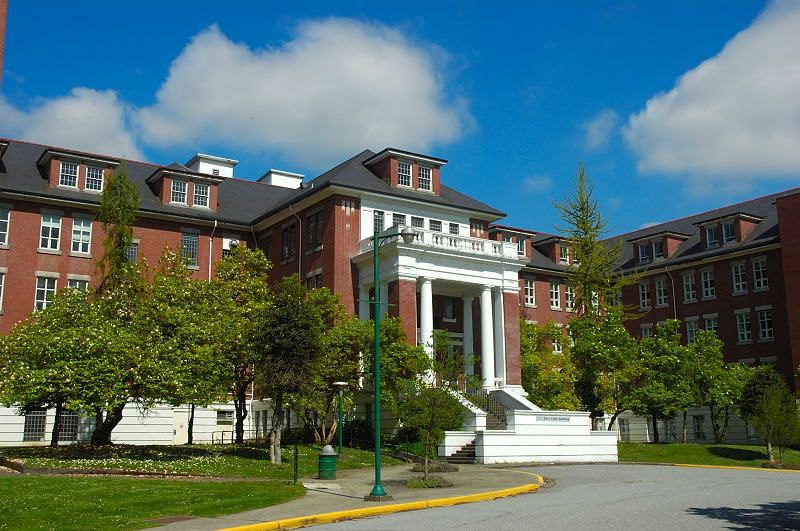

Riverview Hospital was a well-known psychiatric institution. It was officially closed in 2012. Until then, it operated under the direction of BC Mental Health & Addiction Services. In December 2015, the government announced its intention to build new premises for the institution. It was planned to be done in 2019. However, construction work has never begun.
For some time, Riverview was called Essondale Hospital for Dr. Henry Esson Young, who was one of the founders of the psychiatric clinic.
In this article, we will tell more about the history of Riverview, which once was one of the largest psychiatric hospitals in British Columbia.
Learn more about it at ivancouver. (Source: niftyniall)
Prehistory
In 1876, Royal Hospital was transformed into the first hospital for the mentally ill.
As Royal Hospital was overcrowded, it was closed and the patients had to be accommodated in a new provincial mental asylum.
However, it became too small as well, so the government had to solve this problem.
Thus, in 1904, the city bought a 400-hectare plot of land to build a psychiatric hospital. The construction began in 1909.
Creation of a botanical garden
1911 was marked by the creation of an arboretum and botanical garden on the hospital grounds. This was the merit of the provincial Vancouver botanist John Davidson.
Patients were also involved in gardening as a part of their therapy. However, in 1916, the botanical garden was transferred to the University of British Columbia, while the arboretum remained part of the hospital.
New unit
The permanent psychiatric hospital was established in 1913 and started to treat 300 mentally ill men.
The building was originally designed to accommodate 480 patients, but by the end of the year, there were 919 patients.
New status
A new unit treating acute psychopathy was opened in 1924. It was called Centre Lawn. Some of the hospital staff lived in remote areas, so in 1927, it was decided to turn the entire hospital territory into a small settlement. Therefore, shops, a school and a fire station started to be constructed there.
Expansion
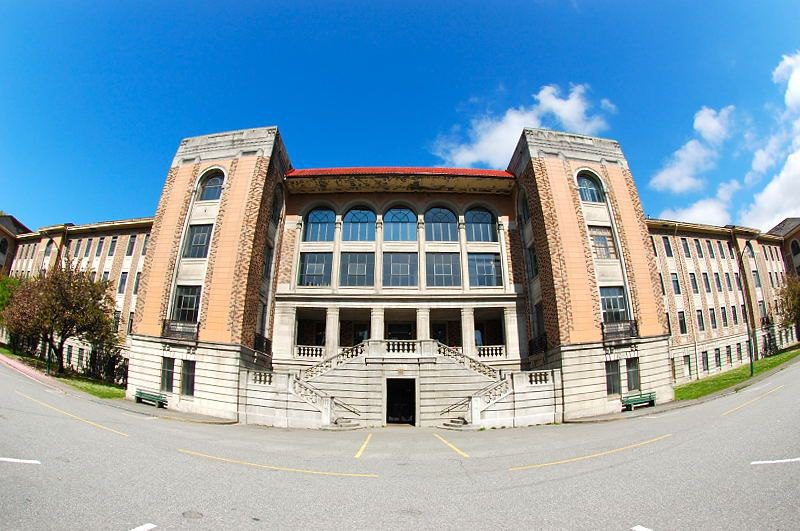
In 1930, another overcrowding led to the opening of the Female Chronic Unit, which treated 645 people.
The Veteran’s Unit was opened in 1934. In 1949, the hospital underwent another significant expansion (including territorial), which gave Riverview its most iconic building.
In 1955, the hospital opened a unit to treat patients who, in addition to mental illnesses, suffered from tuberculosis.
As of 1956, the hospital served 4,306 patients.
In 1959, it was transferred to the Department of Health Services.
Beginning of the end
In the 1960s, the hospital began to decline significantly. The patients began to be administered antipsychotic drugs and other Vancouver hospitals began to open acute-care psychiatric units. In 2004, there were only 800 patients in Riverview.
In 1967, it was decided to downsize Riverview Hospital and finally close it.
An official plan for the hospital closure appeared in 1987.
The transfer of hospital lands to other establishments began from that moment. This process turned out to be quite long-lasting. In 2012, it led to the complete termination of the former psychiatric hospital.
Photo source: wikipedia