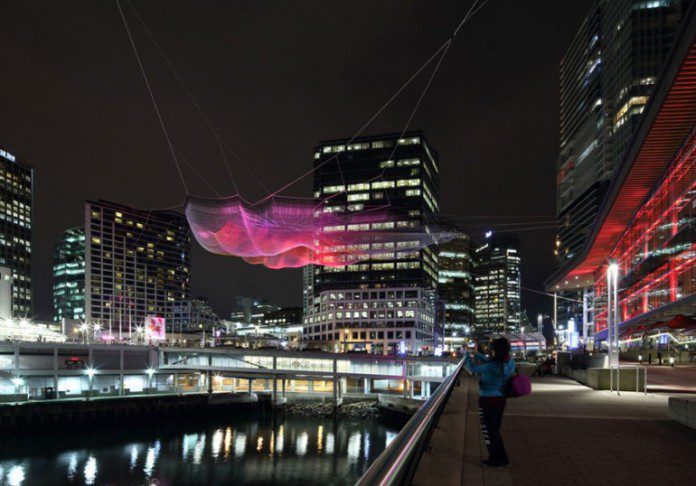

Vancouver is an amazing city where it seems nothing stays still, writes ivancouver. Continuous development extends to practically every aspect of life. This is why nearly every tourist who visits this city once considers staying forever.
It’s fair to say that Vancouver is an especially advantageous place for those looking to successfully realize their professional and creative potential. This city offers an environment conducive to the growth of young professionals and a rapid ascent on the career ladder.
Science is a core sphere of activity in Vancouver. Various scientific events attract attention even from those far removed from the field. These events vividly showcase the successes of Vancouver’s scientists and the significance of their innovations.
In this article, referencing fainaidea.com, we’ll tell you about a Vancouver inventor who created something truly extraordinary. This creation combines the best in technology and modern innovation. It’s a flying sculpture. Intrigued? Join us as we explore this fascinating invention.
An Event That Introduced a Talented Inventor to the World
Vancouver regularly hosts a major scientific event in the form of the TED conference. During this event, visitors are introduced to a wide variety of fascinating developments spanning multiple disciplines. Art and architecture are no exceptions.
Talented inventors come to Vancouver to impress audiences with their innovations. One such conference introduced the world to a Vancouver inventor who created something remarkable. We’re talking about a unique sculpture that can… fly! Yes, fly! Or more accurately, hover in the Vancouver sky, delighting spectators with its presence during the day and its colorful light show at night.
The Pinnacle of a Career
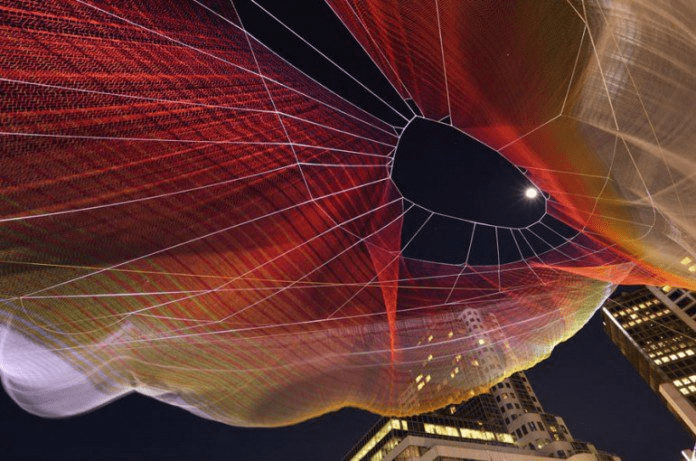
This sculpture, named Annemberd Sparks, was invented by Janet Echelman. The inventor has displayed her works in cities such as New York, Sydney, and Amsterdam.
However, the unique flying sculpture marked a true milestone in Echelman’s career.
The sculpture boasts significant dimensions. Its length is 227 meters, width 145 meters, and height 53 meters. The inventor placed it at a height equivalent to 24-story buildings, anchoring it in Vancouver’s city center between similar high-rises.
Thorough Analysis of the Artwork
In creating the sculpture, Echelman collaborated with a specialized firm that provided access to 3D technology to assemble the structure.
Using computer analysis and programming, the design process allowed the sculpture to be visualized from every angle.
This meant Echelman could evaluate every aspect of her creation, including its proportions and individual components. The technology also facilitated material calculations for the sculpture’s construction.
Of course, all of this became possible through the use of advanced computer systems.
An Unconventional Material
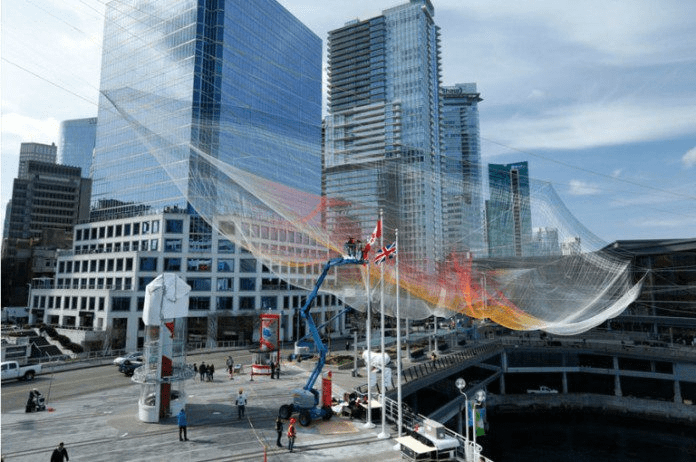
The sculpture’s uniqueness was enhanced by the material used in its creation. It was crafted from Honeywell Spectra fiber, a material 15 times stronger than steel. At the same time, it is so lightweight that even a gentle breeze can give the sculpture its distinctive shape and allow it to “rise” into the air.
At night, the sculpture produces an incredible light show using specialized multicolored lighting. One of the project’s contributors was Aaron Koblin from Google Creative Lab.
When Vancouver residents first witnessed the sculpture’s captivating “dance” illuminated by shimmering colors, they were thrilled. Videos of the stunning display continued to appear on Vancouverites’ social media accounts for weeks afterward.