

In October 1918, Vancouver faced the first wave of the Spanish flu.
In this article, we will tell you how the city coped with the terrible epidemic. Learn more at ivancouver. (Source: vancouverandus.com)
Shortage of medical workers
Many medical workers, both doctors and nurses, had not yet returned from European countries, where they had gone to serve during World War I.
At that time, there were only 200 nurses in Vancouver. Many of them fell ill too, while others had to care for their loved ones who got infected.
Thus, hospitals were catastrophically short of medical workers.
Three waves of the epidemic
While some cities survived only one wave of the Spanish flu, Vancouver faced three waves in October 1918, January and March 1919.
High mortality
Vancouver’s population was about 100,000 at the time. 30,000 people were infected and 900 died. The majority were between 20 and 40 years old and some of them were pregnant women.
Vancouver was the city with the highest mortality rate.
Thus, 55,000 people died from the Spanish flu in the whole of the country.
By the way, almost the same number of Canadians, 60,000, were killed in World War I.
Basic rules
When Vancouver became the epicentre of the Spanish flu, the city established three rules — clean mouth, clean skin and clean clothes.
So, the main focus was on cleanliness instead of stopping the spread of the virus.
Recommendations
The government recommended the local population cover their mouths when coughing, air their homes, keep their feet dry and wear clothes that cover their necks. As for children, it was recommended to use individual pacifiers. It was also advised to kill flies because they could spread the infection. It was also necessary to monitor the cleanliness of school desks.
Quarantine measures
Almost the entire population of Vancouver was quarantined and local residents had signs on their doors informing about infected people inside.
Uncancelled event
Despite the fact that all mass events were banned, the pandemic couldn’t cancel the march celebrating the end of the war and the return of Canadian soldiers from the front. Thus, the victory managed to overshadow the horror caused by the Spanish flu.
Normal operation of schools
Interestingly, despite quarantine measures and high mortality rates, Vancouver schools operated as usual. After all, each school had doctors and nurses.
However, all other institutions were closed, with the exception of enterprises. Churches had to hold services right on the street.
Scarce thing
At the time, a truly scarce thing became ordinary camphor. It was a very popular remedy for coughs. However, people decided that it could also be used to treat the flu. Therefore, within one week, the cost of a pound of camphor increased from 40 cents to $6.5.
Masks
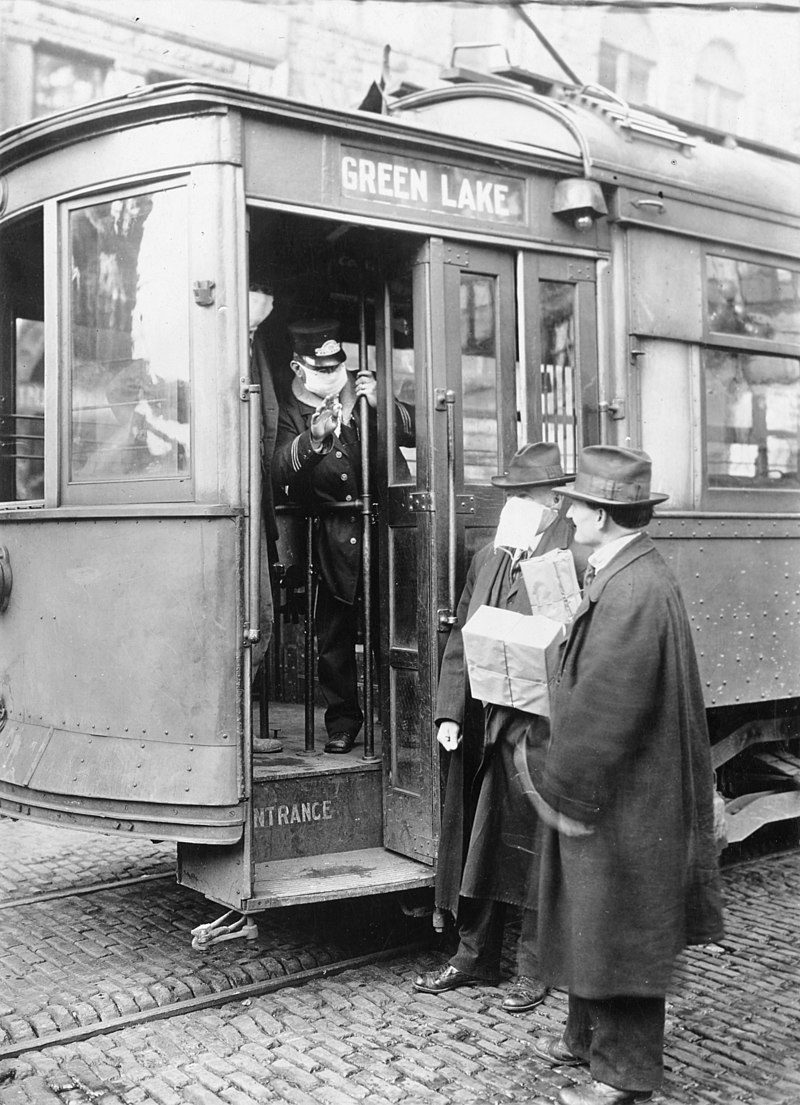
While Seattle, Saskatchewan and Alberta introduced a strict mask regime, Vancouver decided to limit itself to recommendations for wearing masks. Therefore, almost nobody in the city wore masks. The only exception was the Japanese who followed doctors’ recommendations.
Unusual population reaction
Interestingly, when Vancouver was the epicentre of the Spanish flu spread, there was no panic in the city at all. Archival photos prove that the city had a completely normal appearance at that time.
Most likely, people treated the epidemic as another sad element of the four-year war.
Photo source: wikipedia