

Vancouver is a city where science develops at a very rapid pace, writes ivancouver. This progress is evident in almost every aspect of scientific activity. The city does everything possible to ensure that scientists feel supported and inspired to make new discoveries and inventions. Additionally, Vancouver hosts numerous exhibitions showcasing the achievements of researchers. Participation in such exhibitions is often rewarded. Many colleges, institutes, and universities in Vancouver also provide government grants to the most talented and capable students. These young individuals represent the future of the country, and many are likely to join Canada’s scientific community after completing their education.
This environment gives Vancouver scientists even more motivation to create something exceptional and impactful.
In this article, based on techno.bigmir.net, we will tell you about a Vancouver inventor who created something truly remarkable. His invention earned him a place in the legendary Guinness Book of World Records.
A Passion Leading to Invention
Vancouver inventor Jonathan Tippett has always been fascinated by dynamics—whether in mechanisms or people. This passion for motion drove him to design and create the world’s largest tetrapod exoskeleton. He named his creation Prosthesis.
Dimensions of Prosthesis
The dimensions of Prosthesis are impressive. The device stands nearly four meters tall, is five meters long, and measures five and a half meters wide. It weighs over one and a half tonnes.
A Lifelong Aspiration
According to Jonathan, his goal was to create a machine that would celebrate humanity’s age-old pursuit of physical and technical mastery. To achieve this, he incorporated numerous modern technologies into his invention.
The legs and torso of the exoskeleton are made from chrome-moly steel tubing—a highly efficient material frequently used in aerospace and high-performance automotive industries.
How It Works
Jonathan describes the heart of the machine as a custom-built 96-volt lithium-ion battery. This powers AC motors that, in turn, drive hydraulic pumps. These pumps deliver fluid to hydraulic cylinders, each capable of generating 12,000 pounds of force.
A Long and Arduous Journey
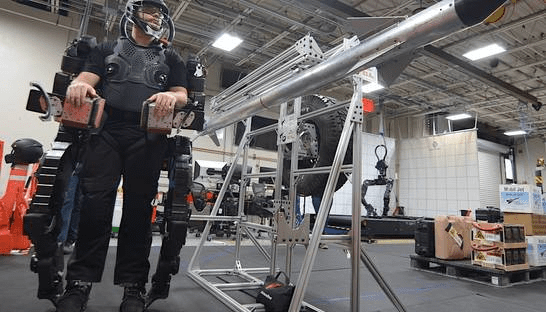
It took Jonathan thirteen years to design and build this colossal exoskeleton. Despite the time and effort invested in the project, he admits that Prosthesis is more of a first prototype. His future plans include creating a smaller, lighter version of the machine.
An Unexpected Recognition
Thanks to this exoskeleton, Jonathan secured a spot in the Guinness Book of World Records. He considers earning this title a tremendous honor and privilege. As a child, he fondly remembers flipping through the pages of the legendary book, never imagining he would one day be part of it himself.
Jonathan admits that breaking a record was never part of his plans. This recognition came as a delightful surprise to him and his entire team.